
Blog
Real Sp5der Hoodie or Fake? The Complete Buyer’s Guide

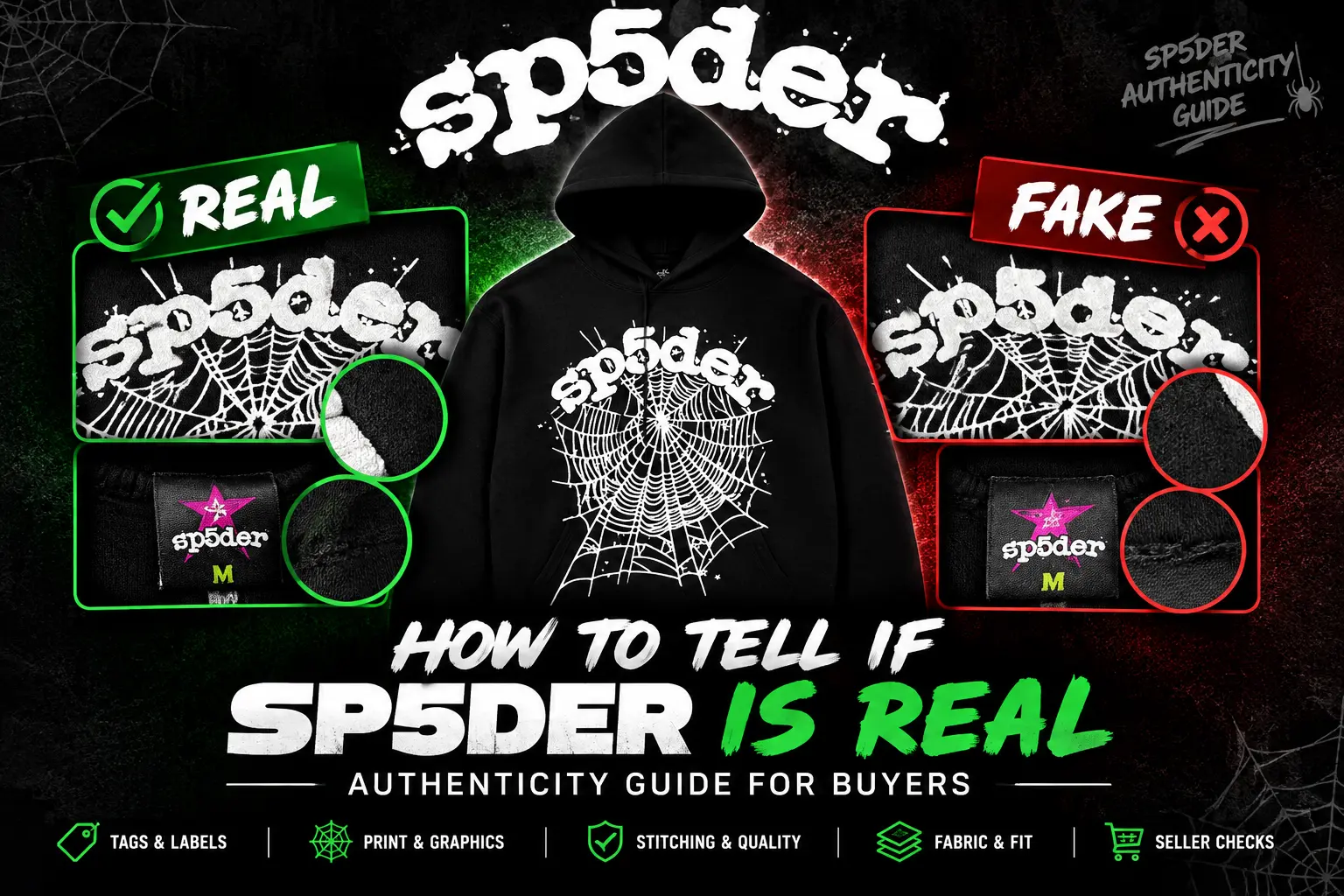
So you found a Sp5der hoodie online, the web print looks fire, and the price is decent enough that you want to hit “buy” right now. Stop for one second, friend. Sp5der is one of the most copied streetwear brands out there, and copies range from obviously bad to genuinely scary good. I’m not here to lecture you or scare you off buying — I just want you to check the right five or six things before your money leaves your account. It takes two minutes and saves you a return fight, or a total loss if you paid through a sketchy method. Let’s walk through it exactly like I’d tell a friend at the mall.
The 30-Second Version
Short on time? Check these five things first. If two or more feel off, walk away.
- Weight — it should feel like a heavy, dense hoodie in your hands, not a light cotton blend
- Print — the puff or web graphic should be raised evenly with clean edges, no shiny “sticker” look
- Tag — the neck tag font and the stylized “5” should look sharp and consistent, not smudgy or off-model
- Price — if it’s dramatically under retail or resale value with no explanation, be suspicious
- Seller — real accounts have history, reviews, and will happily send more photos on request
Quick Refresher: What Sp5der Actually Is
Sp5der, sometimes written Sp5der Worldwide, is the streetwear label built around Young Thug, known for its loud spider-web graphics, puff-print detailing, rhinestone accents, and boxy, oversized silhouettes. It launched pieces that quickly became hype items: hoodies, tees, sweatpants, and denim in bold, sometimes eye-searing colorways. Because pieces drop in limited batches and resell well above retail, the brand attracts serious hype, and serious counterfeiters right alongside it.
It helps to know this upfront because “Sp5der” also gets used loosely online. Some listings mix it up with Spyder, the ski brand, or generic spider-graphic hoodies that have nothing to do with Young Thug’s label. If a listing’s photos look like plain fleece with a web slapped on, you might just be looking at an unrelated cheap hoodie rather than a fake of the actual brand, which is its own kind of problem when you’re trying to buy the real thing.
Why There Are So Many Fakes Right Now
Three things make Sp5der a magnet for counterfeiters: hype, math, and reproducibility.
Hype means limited drops sell out in minutes, so shoppers who miss them turn to resale and secondhand marketplaces, exactly where fakes hide best.
Math means authentic pieces resell well above their tag price, so even a mediocre fake sold at a modest price still nets a counterfeiter solid profit.
Reproducibility means the brand’s graphics are bold and photograph well, which makes them look easy to copy from a distance. What counterfeiters can’t easily nail is fabric weight, the precision of the puff print, and the small construction details up close, which is exactly where you’re about to look.
The Two-Minute Triage (Do This Before You Even Message the Seller)
Before you get into fabric tests, run this quick pass on the listing photos alone:
- Compare the price to recent resale prices for that exact drop and colorway. A brand-new grail piece priced way under market with no explanation is a red flag, not a lucky find.
- Zoom into the graphic. Look for jagged or blurry web lines, uneven puff height, or rhinestones that drift off the pattern.
- Look at the neck tag photo. Compare the font and the stylized “5” against verified photos from the brand’s own site or social pages for that release.
- Check the seller’s history. New accounts, zero reviews, and stock photos borrowed from other listings are common with counterfeit sellers.
- Ask for one extra photo they probably don’t have ready, like the inside pocket bartack or a care label close-up. Genuine sellers snap it in ten seconds. Scripted or evasive sellers stall.
If two or more of these feel off, don’t move forward yet. Ask more questions or walk away.
Check #1: Fabric Weight and Handfeel
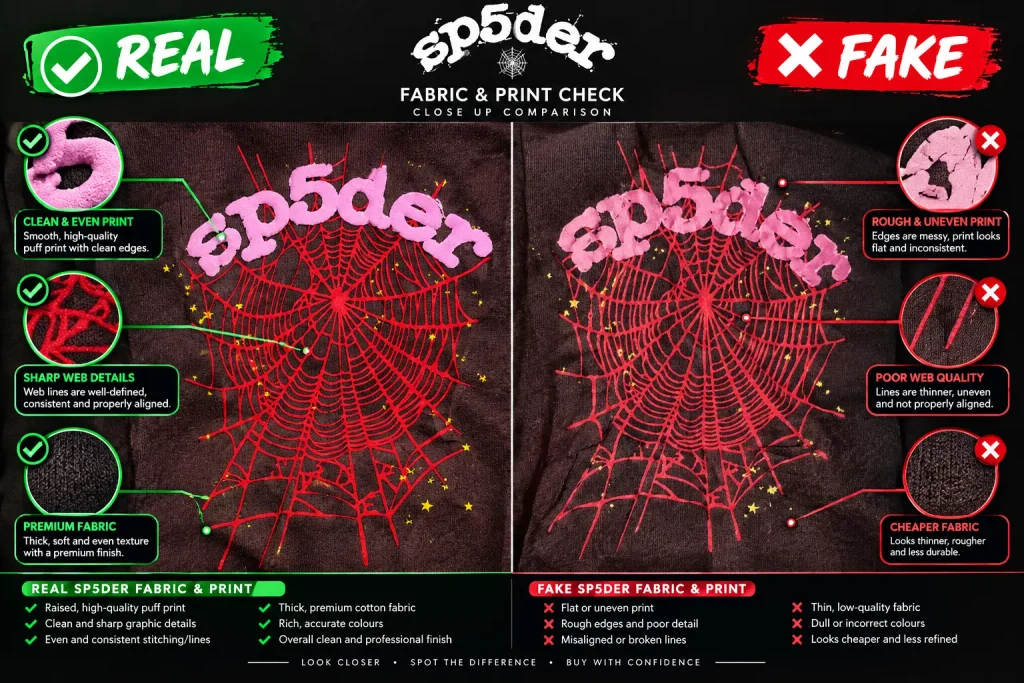
Real Sp5der hoodies are heavyweight pieces: dense, brushed fleece with real substance in your hands, not something that flutters like a t-shirt. A few physical tests:
- Handfeel — authentic fleece feels thick and slightly textured on the inside, with a soft brushed nap. Cheap fakes often feel thin, papery, or oddly slick.
- The light test — hold the body fabric up to a bright light or window. Authentic heavyweight fleece blocks most light; if you can clearly see your hand’s outline through it, that’s a lightweight blank, not the real deal.
- Ribbing snapback — gently stretch the cuff and waist ribbing, then let go. Good ribbing snaps back into shape almost immediately. Ribbing that stays stretched out or looks saggy is a common corner cut on fakes.
- Drape — hold the hoodie up by the shoulders. A heavyweight piece hangs with real weight and structure, while cheap fleece looks floppy and thin at the hem.
None of these tests alone proves anything, but stack two or three failures together and you’re likely holding a fake.
Check #2: The Print and Graphics
This is where most fakes fall apart under close inspection, even when they look convincing in listing photos.
- Puff print height — authentic puff-print sections should rise evenly across the whole design, not just in spots. Uneven or partially flat puff print is a strong tell.
- Edge sharpness — zoom in on the outline of the web graphic. Real prints have crisp, clean edges. Fakes often show blurry, feathered, or bleeding edges where the ink spread beyond the design.
- The bend test — gently flex the fabric where the print sits. Quality prints show tiny, fine cracking in the ink without lifting off the fabric. Cheap vinyl-style prints tend to wrinkle in thick creases or peel at the corners.
- Glue halo — tilt the garment under a lamp and look at the print from an angle. A shiny ring of adhesive around the edges of the design usually means it’s a cheap heat transfer rather than the brand’s actual print process.
- Rhinestone placement, on pieces that use them — stones should sit tightly and precisely along the design lines. Loose, crooked, or randomly scattered stones are a classic fake tell.
Check #3: Tags and Labels
SP5DER Real vs Fake: How to Check Authenticity
Want to see the authentication process in action? Watch this in-hand SP5DER real vs fake comparison and learn what details to check before buying.
Use the video together with the checks in this guide, including labels, graphics, stitching, fabric and overall construction.
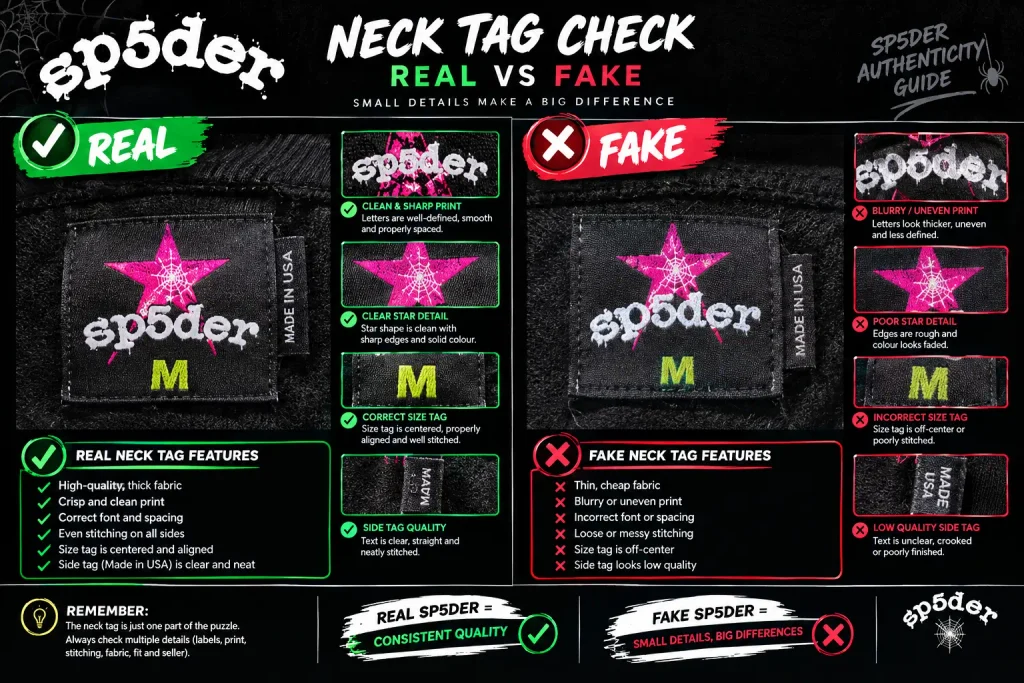
Tag details genuinely change between drops. Sp5der has used different neck label styles, care tag formats, and hangtag designs across different releases, so don’t treat any single tag layout as the one true version. Instead, check for internal consistency and craftsmanship:
- Typography — the SP5DER wordmark, including the stylized “5,” should look sharp, evenly spaced, and identical to verified photos from that specific drop. Wobbly letters, inconsistent spacing, or a “5” that looks like a plain number rather than the brand’s styled version are red flags.
- Care label — check the fabric composition and washing instructions text. Genuine care labels have clean, even printing with no odd capitalization or garbled wording. Blurry or crooked printing is common on fakes.
- Attachment quality — tags should be neatly and securely sewn in, not glued, crooked, or barely hanging on by a thread.
- Cross-reference — whenever possible, compare the seller’s tag photos side by side with official product images from that same drop, whether from the brand’s own site, official social posts, or a trusted resale platform’s listing photos. Small inconsistencies jump out fast this way.
Be upfront with yourself here: tags alone aren’t a foolproof test, since good counterfeiters can copy a tag closely. Use it as one data point among several, not the final word.
Check #4: Stitching and Construction
Flip the garment inside out. This is where a lot of shortcuts hide.
- Coverstitch at the hood — look for even, consistent stitching along the hood seam. Skipped stitches or wavy lines suggest rushed production.
- Overlock seams — interior seams should be neatly finished with no fraying or loose threads hanging out.
- Bartack reinforcement — check the top corners of the kangaroo pocket. Genuine pieces reinforce stress points with a dense bartack stitch. Missing or sloppy reinforcement here is a common fake shortcut.
- Drawstrings and eyelets — cords should be sturdy and even on both sides, and the eyelets they run through should sit flat without sharp edges or visible glue.
- Hem evenness — lay the hoodie flat and check that the bottom hem sits level all the way around, without puckering or uneven length.
Not sure which size to grab? Check our Sp5der size guide before you buy — fit issues are one of the easiest ways to end up disappointed even with a genuine piece.
Check #5: Pricing and Seller Behavior
Price alone can’t confirm authenticity, but pricing patterns tell you a lot when you look at the full picture.
- Know the retail range for the piece type, whether hoodie, tee, or sweats, and where recent resale for that colorway has actually landed. A big, unexplained gap below both numbers deserves scrutiny.
- Ask sellers for unedited photos in natural light, plus a few extra close-ups you choose yourself rather than ones they already posted. Counterfeit sellers often reuse the same stock images across multiple listings.
- Run a reverse image search on the listing photos. If the exact same images show up across a dozen unrelated storefronts, that’s a strong signal you’re looking at a dropshipped fake, not a real seller’s own stock.
- Be cautious with sellers who pressure you to pay through friends-and-family transfers, gift cards, or off-platform payment apps. These skip the buyer protections that would normally let you dispute a fake.
Real vs. Fake, Side by Side
| What to Check | Authentic Sp5der | Likely Fake |
| Fabric weight | Heavyweight, dense, blocks light | Thin, light glows through easily |
| Ribbing | Snaps back quickly, holds shape | Stays stretched, saggy |
| Print edges | Crisp, clean, no bleeding | Blurry, feathered, halo of glue |
| Puff print | Rises evenly across the design | Patchy, partially flat |
| Rhinestones | Tight, precise, on the design line | Loose, crooked, scattered |
| Tag typography | Sharp, consistent, matches verified drop photos | Wobbly spacing, off-model “5” |
| Stitching | Even coverstitch, reinforced bartacks | Skipped stitches, missing reinforcement |
| Price | Matches retail and resale patterns | Unexplained deep discount |
| Seller | Established history, answers questions, real photos | New account, stock photos, evasive |
Where to Actually Buy Safely
The lowest-risk path is always the brand’s own official channels, its website and verified social accounts for drop announcements, since that removes the authenticity question entirely.
For resale or secondhand pieces, lean on platforms that build in buyer protection and authentication:
- Marketplaces that hold payment until you confirm receipt, rather than sending money directly to a stranger
- Consignment-style platforms with their own inspection process before a piece ships to you
- Communities and groups with seller reputation systems, where you can check past transaction history
Wherever you buy, use a payment method that lets you open a dispute if something goes wrong. A proper buyer-protection checkout beats a direct bank transfer or a friends-and-family payment, which offer you no recourse at all.
One Clue Isn’t Enough — You Need the Whole Picture
Here’s the mindset shift that matters more than any single test: a counterfeiter can nail one detail. Getting five or six details right at once is a lot harder.
So don’t stop checking just because the tag looks convincing. Say the neck tag passes, but then you notice the graphic sits slightly crooked, the pocket stitching looks nothing like reference photos, the fabric feels thinner than it should, and the seller goes quiet when you ask where they got it. That combination tells a different story than the tag alone did.
Flip it around, and the same logic works in your favor. If the release is easy to identify, the seller has a track record you can actually check, the labels line up with references, the graphics match that specific drop, the construction looks right throughout, the fit makes sense, and the purchase history feels plausible — that’s a stack of evidence pointing the same direction, and that’s what real confidence looks like.
Treat every check as one vote, not a verdict. Count the votes before you decide.
Already Bought It and Now You’re Not Sure? Here’s What to Do
First — don’t spiral. A wave of doubt after checkout doesn’t mean you got scammed, it just means it’s time to gather evidence calmly.
Hold onto everything:
- Your order confirmation
- Every message you exchanged with the seller
- The original product listing (screenshot it if it could disappear)
- Any photos the seller sent you
- Your payment receipt
- Shipping and tracking info
- The packaging it arrived in
- Your own photos of the item once it’s in hand
Then take clear, well-lit photos of the piece itself — tag, print, stitching, all of it.
If you bought through a platform or payment method with buyer protection, don’t touch anything you might need later until you’re genuinely satisfied. If you’re convinced it’s counterfeit, message the seller first when that’s a reasonable option, then follow the platform’s actual dispute or return process rather than going around it. And whatever you do, don’t cut off tags or toss packaging while any of this is still unresolved — you might need it as proof.
Things People Think Are Proof… But Really Aren’t
A lot of “authentication” advice floating around is really just vibes. Here’s what to stop leaning on:
- “It came with a dust bag.” Packaging is easy to source separately. Not proof.
- “The seller has a perfect review score.” Genuinely reassuring, but reviews don’t inspect the item for you.
- “It has the right logo.” Logos get copied constantly. Not enough on its own.
- “It feels heavy in my hands.” A good sign, but weight alone doesn’t clear an item.
- “The QR code scanned fine.” Codes can be duplicated. Working isn’t the same as authentic.
- “The seller swears it’s real.” That’s a claim, not evidence — anyone can say it.
- “I paid a lot for it.” Price doesn’t authenticate anything by itself.
- “It looks identical to the listing photos.” A good sign, sure, but listing photos can be lifted from somewhere else entirely.
- “Some guy on TikTok said this tag style is legit.” Useful as one more reference point, not an official ruling.
None of these are worthless as supporting signals — they’re just not enough by themselves. Fold them into the bigger picture instead of treating any one of them as the final word.
What About the “Made In” Label?
Don’t throw out an otherwise solid piece just because the country of origin isn’t what you expected. Brands shift factories, suppliers, and production setups between releases all the time — that alone isn’t suspicious.
The question worth asking isn’t “does this match what I assumed the brand always does?” It’s “does this match credible references for this specific release?” That’s exactly why comparing against the right drop — not the brand in general — matters so much.
Can a QR Code Actually Prove Anything?
Treat QR codes with a healthy dose of skepticism. They can absolutely be copied and printed onto a fake tag just as easily as a real one.
If a piece has one, don’t stop at “it scanned.” Dig a little further:
- Where does it actually send you?
- Does that destination have anything to do with the real brand?
- Does what you find there match the product in front of you?
- Does the physical item agree with whatever the digital page claims?
A QR code that checks out on all four of those is a decent supporting clue. A QR code that just “works” and nothing more isn’t proof of anything.
Buying From a Reseller? Don’t Be Shy About Asking for Photos
If you’re buying secondhand or through a marketplace, you’re allowed to ask for more than what’s already posted. A seller with nothing to hide won’t mind. Here’s your ask list:
- Front — overall shape and proportions
- Back — rear graphic and construction
- Neck tag — a real close-up, not a thumbnail
- Care and size labels — every inside label, clearly
- Pocket — great for comparing stitching and graphic alignment against references
- Sleeves and cuffs — shows construction quality and honest condition
- Print close-up — ask for natural light, not a filtered or heavily edited shot
- Packaging — nice supporting evidence, though not proof on its own
- A timestamp photo — the item next to a handwritten note with today’s date or your username
Red Flags Cheat Sheet
Save this list for next time you’re staring at a listing:
- Price is dramatically below known retail or resale value
- Seller has no history, no reviews, or a brand-new account
- Photos look pulled from a catalog rather than an actual item in hand
- Seller refuses or stalls when you ask for extra close-up photos
- Fabric looks thin or glows through under light in photos
- Print edges look blurry, shiny, or stickered on
- Tag typography looks off compared to verified drop photos
- Payment is pushed toward untraceable methods with no buyer protection
Using YouTube and Video Reviews the Smart Way
Video is genuinely one of the best authentication tools you have, because it shows fabric weight, print texture, and stitching in motion, things a flat photo hides easily. A few honest notes on using it well:
Search directly for the specific piece: the drop name plus “unboxing,” “review,” or “in hand” tends to surface real owners showing off actual stitching and fabric close-ups, which is far more useful than a generic “real vs fake” search that might pull up an outdated video about a totally different release.
Favor creators who show rather than tell. Look for videos where someone flips the garment inside out, zooms into the print, and stretches the ribbing on camera, rather than ones that just talk over stock photos.
Match the video to your actual product. Sp5der’s construction details have shifted across drops, so a two-year-old video about a different hoodie style won’t tell you much about this season’s piece. Check that the video’s release matches the year and colorway you’re checking.
One honest note: I’m not going to drop specific video links here, since channel content and accuracy shift constantly and a link that was solid last month can age badly. You’ll get more value judging a video’s credibility yourself, in-hand footage, clear close-ups, a real product in front of the camera, than trusting any single link blindly. Search the exact drop name plus “review” and take it from there.
Quick Questions People Actually Ask
Does Sp5der use holograms or serial numbers on every piece? Not consistently. Authentication features change across drops and product types, so don’t treat a missing hologram alone as proof of a fake, or a hologram alone as proof it’s real.
Can I fully authenticate from photos alone? You can get a strong read, especially combining tag, print, and pricing checks, but an in-hand check involving weight and stretch is more reliable when the price is high enough to matter.
What if the seller refuses extra photos? Treat that as a real red flag on its own. Legitimate sellers with nothing to hide usually snap one more picture without much pushback.
Is a cheaper budget version automatically fake? Not if it’s sold honestly as a budget piece. But if it’s being sold or implied as the genuine brand at a bargain price, that’s the exact setup counterfeiters use.
Should I trust a certificate of authenticity included with the item? Treat it as a nice bonus, not proof. These are easy to fabricate. Lean on the physical checks above instead.
Where’s the safest place to double check before I commit? Compare against verified photos from the brand’s own official channels for that specific drop, and don’t be afraid to ask in streetwear communities where experienced buyers can weigh in.
The Bottom Line
None of these checks are complicated. You’re just slowing down enough to actually look. Feel the fabric, zoom into the print, read the tag carefully, and pay attention to how the seller behaves. Stack two or three of these together and you’ll catch the overwhelming majority of fakes before your money’s gone. Happy hunting, and enjoy the real thing once you land it.
One thought on “Real Sp5der Hoodie or Fake? The Complete Buyer’s Guide”
Comments are closed.
Hi, this is a comment.
To get started with moderating, editing, and deleting comments, please visit the Comments screen in the dashboard.
Commenter avatars come from Gravatar.